


No-Code AI Agent Platform for Operations: How CEOs Scale Execution Without Scaling Headcount
A no-code AI agent platform for operations lets your team create “AI Workers” that run end-to-end processes—across systems like CRM, ERP, ticketing, and spreadsheets—without software engineering. Instead of automating single tasks, these platforms orchestrate decisions, approvals, and system updates so operational work gets done faster, with fewer handoffs and less rework.
As a CEO, you don’t lose sleep over whether your company can “use AI.” You lose sleep over whether you can hit growth targets while margins tighten, hiring stays constrained, and operational complexity keeps climbing. Your org isn’t short on effort—your best people are simply trapped in execution: status chasing, data cleanup, reconciliations, escalations, and a thousand small steps that make the business run.
That’s why the next wave of operational leverage isn’t another dashboard or another automation tool that needs months of IT capacity. It’s an AI workforce—AI agents that execute real workflows the way your operators already do, inside the systems you already own. And crucially, it’s no-code: built by the people who know the process best, with guardrails that IT and Security can live with.
In this guide, you’ll learn how CEOs evaluate a no-code AI agent platform for operations, which workflows to start with, how to avoid “pilot purgatory,” and how EverWorker’s “Do More With More” model helps you scale capability and capacity—without burning out your team.
Why operations bottlenecks persist even after “automation”
Operations bottlenecks persist because most automation tools handle tasks, not outcomes. When work spans multiple systems, includes exceptions, and requires judgment, teams end up re-checking, re-keying, and re-routing work—so cycle time and costs stay high even after you “automate.”
From a CEO seat, the symptoms are easy to recognize:
- Cycle times creep up as volume increases (ticket backlogs, invoicing delays, order exceptions, slow onboarding).
- Quality becomes inconsistent because process adherence depends on tribal knowledge and individual heroics.
- Reporting is fragile because the underlying data is patched together by humans under deadline pressure.
- Leaders ask for more headcount not because the team is ineffective, but because the system is overloaded.
The root cause isn’t effort—it’s architecture. Traditional automation typically breaks at the exact point your operation gets valuable: exceptions, approvals, judgment calls, and cross-system handoffs. That’s also where “AI copilots” often stop: they can suggest, draft, or summarize, but they can’t reliably do the work end-to-end.
What CEOs actually need is operational execution that scales: workflows that run continuously, log actions, follow policies, and escalate edge cases with full context. That’s the difference between automation as a tool—and AI Workers as a capacity layer.
What a no-code AI agent platform for operations actually is (and isn’t)
A no-code AI agent platform for operations is software that lets business teams build, deploy, and manage AI agents that execute workflows across your systems—using natural-language instructions and configurable connections—without writing code.
To ground the term “no-code,” IBM defines it as a software development approach that enables users to create applications and automate business processes without writing code (IBM). In practice, for operations, “no-code” only matters if it moves beyond simple forms and triggers into real process execution.
What it is: delegated execution across systems
It is a way to delegate operational work to AI in the same way you delegate to a capable operator: you define the job, provide knowledge, connect tools, and set escalation rules.
EverWorker frames this clearly: if you can explain the work to a new hire, you can build an AI Worker to do it (Create Powerful AI Workers in Minutes).
What it isn’t: another chatbot or a brittle script
It isn’t a generic chat interface that requires humans to copy/paste between tools, and it isn’t a brittle “if-this-then-that” flow that breaks when reality changes.
For CEOs, the litmus test is simple: Does it close the loop? For example, “resolve the ticket,” “post the invoice,” “update the CRM,” “collect the missing document,” “route for approval,” “notify stakeholders,” and “log everything.” If your AI can’t take the last step, your people still carry the operational load.
How CEOs should evaluate a no-code AI agent platform (the non-negotiables)
The right no-code AI agent platform reduces operating friction while increasing control. For a CEO, that means speed-to-value and governance, not one or the other.
Can it automate end-to-end workflows, not just tasks?
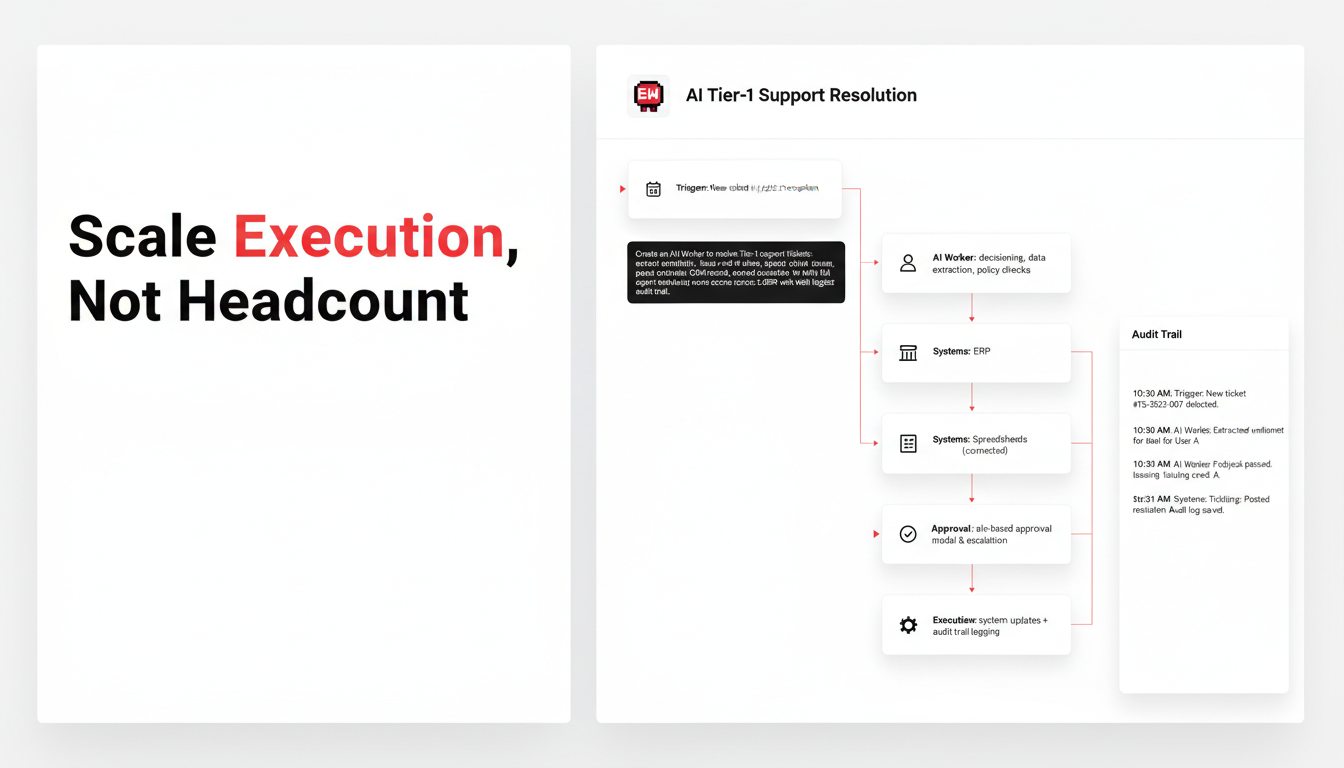
End-to-end automation means the agent can execute a complete process: intake → decisioning → system updates → approvals → exception handling → handoff → audit trail.
EverWorker positions AI Workers as “teammates you delegate to,” built for full workflow execution—not just assistance (AI Solutions for Every Business Function).
Does it connect to the systems where work actually happens?
A platform must reach into the systems of record—CRM, ERP, ticketing, HRIS, shared drives, email—because operational work lives in those tools, not in a standalone AI interface.
As you evaluate platforms, insist on clarity around:
- Supported integrations (native connectors, APIs, MCP-style connections)
- Write access controls (what can the agent change vs. only read)
- Event triggers (webhooks, schedules, record changes)
- Last-mile execution (browser-based steps when no API exists)
Is governance built-in, or bolted-on?
Governance must be native: role-based permissions, approval workflows, separation of duties, and an attributable audit history. Without that, no-code becomes shadow IT at scale—exactly what you can’t afford.
If your organization is already working through AI governance and operating model questions, EverWorker’s broader strategy guidance is a useful reference point (AI Strategy Best Practices for 2026: Executive Guide).
Will you be locked into consultants or custom code?
The goal is independence. A platform should let your teams iterate quickly as processes change—without a six-month backlog or a permanent SI dependency. The “win condition” is compounding capability: each AI Worker makes the next one easier to create, deploy, and govern.
High-ROI operations use cases to start with (the CEO shortlist)
The best initial use cases are high-volume, rules-plus-exceptions workflows that cross multiple systems and currently consume expert time. These create immediate ROI and build confidence without betting the company on a moonshot.
What operational processes should you automate first with AI agents?
You should automate the processes where handoffs, rework, and exception handling drive cost-to-serve: support resolution, quote-to-cash exceptions, invoice and reconciliation workflows, returns/RMAs, and onboarding operations.
- Customer support Tier-1 resolution + escalation packaging: resolve routine issues, pull entitlement data, issue credits within policy, and escalate edge cases with full context.
- Order-to-cash exception handling: detect incomplete orders, request missing info, update ERP/CRM, and route approvals based on thresholds.
- AP invoice intake + matching: extract invoice data, match to POs/receipts, route exceptions, post to ERP, and notify approvers.
- Returns and warranty workflows: validate eligibility, create RMA, update logistics systems, communicate status, and close the loop.
- RevOps hygiene (if ops owns CRM integrity): update fields, log activities, create follow-ups, and keep pipeline data clean automatically.
EverWorker publishes examples across functions, including finance, support, and process-heavy workflows that mirror typical operations realities (see the blueprint examples here).
Generic automation vs. AI Workers: the shift CEOs should demand
Generic automation optimizes a step. AI Workers optimize the outcome.
Traditional automation asks: “What can we script?” AI Workers ask: “What can we fully delegate?” That difference matters because your business doesn’t experience pain at the task level—it experiences pain at the process level: missed SLAs, slow close, forecast uncertainty, customer churn risk, and employee burnout.
Here’s the CEO-level reframing:
- Not: “Can AI draft the email?”
Instead: “Can AI run the entire collections sequence, log everything, and escalate exceptions?” - Not: “Can AI summarize tickets?”
Instead: “Can AI resolve Tier-1 tickets and package Tier-2 escalations with the right context and actions taken?” - Not: “Can we automate data entry?”
Instead: “Can we eliminate the workflow that creates data entry in the first place?”
This is where EverWorker’s philosophy becomes strategically important: Do More With More. The point isn’t to squeeze your team harder. It’s to give them leverage—so the same group can deliver a larger operational footprint, higher quality, and faster cycle times.
Get certified, then operationalize: how leaders build internal AI capacity
Even with no-code platforms, companies that win treat AI as a capability, not a one-time project. The fastest path to sustainable results is to build AI literacy across operators and leaders so they can identify workflows worth delegating—and govern them responsibly.
If you want your operations leaders to move from “AI curiosity” to “AI execution,” build a common language around AI fundamentals, agentic workflows, risk tiers, and ROI measurement.
Where to go from here: build one AI Worker that closes a loop
You don’t need a “company-wide AI transformation” to start. You need one operational loop closed end-to-end—one workflow where your team feels the relief immediately and your metrics move visibly.
Pick a process with:
- Clear start trigger (new ticket, new invoice, new order exception, new onboarding event)
- Known steps and policies (even if they live in docs today)
- At least 2–3 systems involved (where humans currently bridge the gap)
- Measurable outcome (cycle time, backlog, cost per unit, SLA, error rate)
Then build an AI Worker the way you’d onboard a strong operator: define instructions, attach the knowledge, connect the systems, and set escalation rules. Once that’s live, your second Worker will be faster—and your third faster still.
FAQ
What’s the difference between a no-code AI agent platform and RPA?
A no-code AI agent platform is built for judgment, exceptions, and multi-step reasoning across systems, while RPA is typically best for deterministic, repeatable UI/API steps. Many companies use both, but AI agents are better suited to workflows that break traditional automations.
How do we prevent “shadow AI” if business teams can build agents?
You prevent shadow AI with platform-level governance: role-based access, approvals, audit trails, and centrally managed integrations. No-code works in the enterprise when guardrails are default, not optional.
How fast can an operations team see results?
With the right first workflow, teams can see value quickly—often within days for an initial working version—then harden and expand into production-grade automation over the following weeks. The key is choosing a process that closes a loop and has measurable outcomes.



 Anton Antich
 Austin Braham
 Christopher Good