


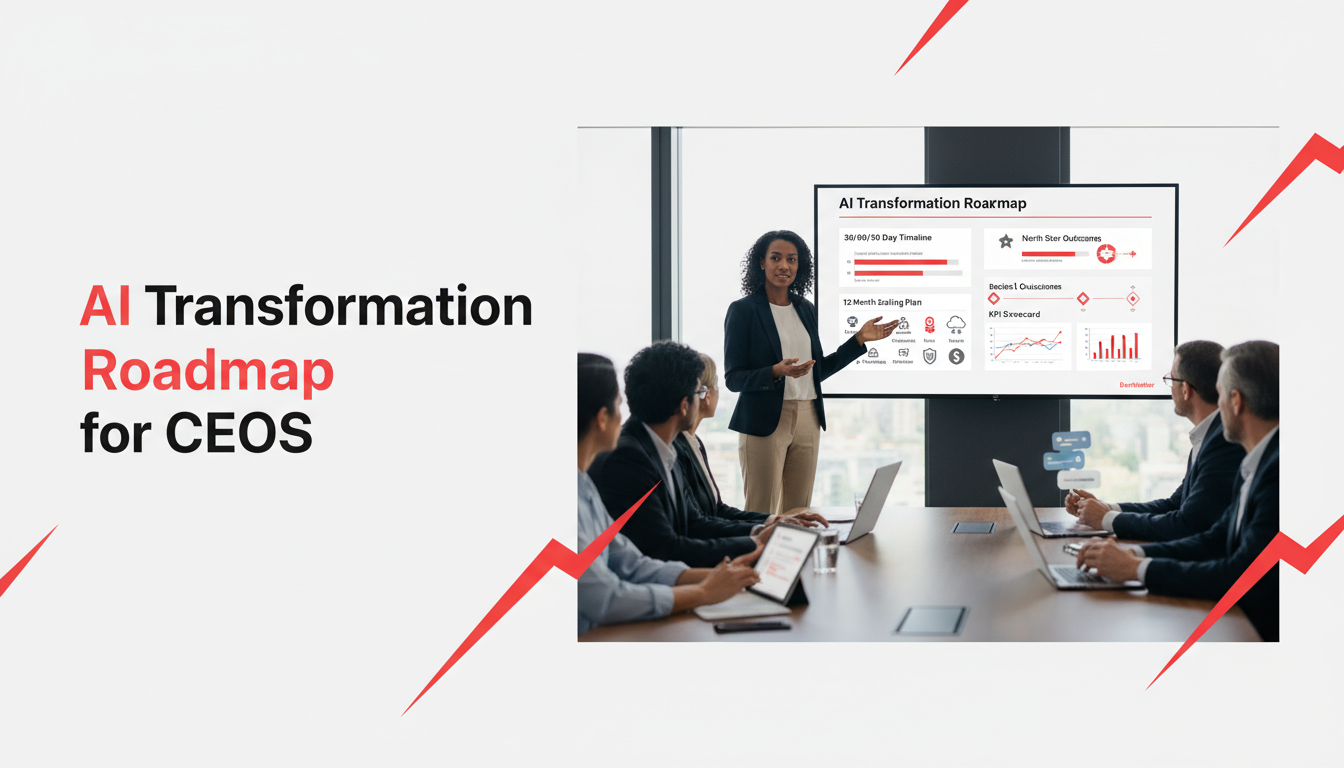
CEO AI Transformation Roadmap Template (Built for Speed, Governance, and Real ROI)
A CEO AI transformation roadmap template is a practical, time-bound plan that aligns AI investments to business outcomes, prioritizes high-ROI use cases, establishes governance and risk controls, and defines how your organization will deliver AI at scale. The best roadmaps balance speed and safety—and turn AI from pilots into an operating advantage.
Most CEOs aren’t asking whether AI matters anymore. The real question is: “How do we turn AI into measurable value—without creating chaos, security risk, or initiative fatigue?”
That’s where most roadmaps break. They either read like a technology shopping list, or they become a multi-quarter “strategy exercise” that never ships. Meanwhile, teams buy point tools, experiment in silos, and you get a familiar outcome: scattered pilots, no compounding results, and a board that wants ROI this quarter.
This article gives you a CEO-ready AI transformation roadmap template you can use immediately. It’s built for midmarket leaders who need momentum fast, but can’t afford reckless experimentation. You’ll get a clear sequence (30/60/90 days + 12 months), decision gates, KPIs, governance, and an “AI workforce” approach that helps your people do more with more—more capacity, more quality, more speed—without a hiring spree.
Why CEOs Need an AI Transformation Roadmap (Not More Pilots)
A CEO-level AI transformation roadmap is necessary because AI creates value only when it is deployed into real workflows with clear ownership, governance, and measurable outcomes.
If you’re feeling pressure from your board, customers, and employees at the same time, you’re not alone. AI has moved from “innovation topic” to “operating model topic.” The trap is that AI is uniquely good at producing impressive demos—while quietly failing to change cycle time, cost-to-serve, or growth velocity.
Most companies hit the same failure pattern:
- Tool sprawl: Every department buys “an AI thing,” and none of it fits together.
- Pilot purgatory: Experiments run, but nothing becomes durable production capability.
- Speed vs. governance conflict: IT wants control; business units want speed; both feel blocked.
- No single value story: You can’t confidently answer, “What did AI do for EBITDA?”
Gartner notes that an AI roadmap should be a concrete sequence of steps to deliver AI business value at scale—and highlights that only a portion of initiatives achieve ROI, with even fewer delivering true transformation. You can see Gartner’s overview here: AI Roadmap: What It Is and How to Build One.
The CEO job is not to “pick the best model.” It’s to align the organization around outcomes, build safe speed, and ensure AI becomes a compounding capability—not a quarterly distraction.
The CEO AI Transformation Roadmap Template (Copy/Paste Structure)
A strong AI transformation roadmap template for CEOs includes outcomes, portfolio, governance, operating model, platform approach, talent enablement, and a delivery cadence with decision gates.
Use the structure below as your living roadmap. It’s designed to fit on a single page in your leadership meeting—and expand into execution detail as needed.
Section A: North Star Outcomes (CEO-Owned)
Your roadmap should start with 3–5 measurable outcomes that tie directly to your corporate strategy and board language.
- Growth: pipeline velocity, conversion rate, retention, expansion
- Efficiency: cost-to-serve, cycle time, rework rate, throughput per FTE
- Risk: compliance exceptions, audit readiness, security incidents
- Experience: CSAT/NPS, employee engagement, time-to-resolution
CEO checkpoint: If a proposed AI initiative doesn’t move one of these outcomes, it’s not on the roadmap.
Section B: Use-Case Portfolio (What We Will Automate First)
Your roadmap should define a portfolio—not a single “big AI bet”—with clear prioritization logic.
- Quick wins (0–90 days): high repetition, clear rules, measurable baselines
- Core transformations (3–12 months): end-to-end workflows across systems
- Strategic bets (6–18 months): new product capabilities, differentiated data advantage
For most midmarket companies, the fastest ROI comes from automating end-to-end processes in:
- Customer support triage + resolution + escalation packaging
- Sales ops + CRM hygiene + research + follow-up workflows
- Finance ops (reconciliation, exception handling, collections workflows)
- Recruiting ops (screening, scheduling, candidate communication, onboarding handoffs)
Section C: Governance & Risk (Speed With Guardrails)
Your roadmap should specify how you will move fast without creating shadow AI or compliance surprises.
- Risk tiers: low/medium/high by use case (customer-facing, financial, regulated data)
- Decision rights: what IT/security approves once vs. what business can ship repeatedly
- Human-in-the-loop rules: what requires approval, what is autonomous, what is logged
- Auditability: action logs, data access controls, versioning of workflows
CEO checkpoint: Governance must enable shipping. If governance only delays, it’s theater—not protection.
Section D: Operating Model (Who Owns Delivery)
Your roadmap should define who sponsors, who builds, who runs, and who measures AI in production.
- Executive sponsor: CEO (or delegated C-level) ensures outcomes and funding alignment
- Functional owners: VPs own use cases and KPIs (not IT alone)
- IT/Security: sets guardrails, integrations, identity, data access patterns
- Finance partner: validates baselines, tracks realized value (AI P&L mindset)
If you want a strong companion read on shifting from experimentation to execution, see: AI Strategy Best Practices for 2026: Executive Guide.
A 30/60/90-Day CEO Roadmap (With Decision Gates)
The most effective CEO AI transformation roadmap starts with a 90-day sprint that proves ROI, establishes governance patterns, and creates momentum to scale.
Days 0–30: Align, Select, and Set the “Rules of the Road”
In the first 30 days, your goal is to turn AI from an abstract priority into a governed execution plan with measurable targets.
- Define 3–5 North Star metrics (growth, efficiency, risk, experience).
- Inventory candidate processes (8–12) across functions.
- Pick 2–3 production-intent quick wins (not “cool demos”).
- Set governance: risk tiers, approval rules, logging and audit requirements.
- Establish baselines: current cycle time, cost, backlog, error rate.
Decision gate: If you can’t baseline it, you can’t claim ROI. Don’t start it.
Days 31–60: Ship the First “AI Workers” Into Real Workflows
In days 31–60, your goal is deployment into systems of record—not another tool your team has to “check.”
- Deploy 1–2 AI Workers that execute end-to-end workflows (with human escalation paths).
- Integrate into daily operations (Slack/Teams, CRM, ticketing, ERP/finance tools).
- Implement monitoring for quality, exceptions, cost-to-run, and risk signals.
- Run enablement for functional leaders so adoption doesn’t stall.
EverWorker’s philosophy is simple: if you can describe the work, you can build the worker. This is a fundamentally faster path than traditional automation programs. Related: Describe the Work, EverWorker Does the Rest.
Decision gate: If it doesn’t touch real systems and close a loop (ticket closed, invoice reconciled, meeting logged), it’s not a win yet.
Days 61–90: Prove ROI, Standardize Patterns, Expand the Portfolio
In days 61–90, your goal is repeatability: a method your company can use again and again.
- Publish the AI scorecard (North Star metrics + use-case KPIs).
- Codify reusable patterns (integration approach, guardrails, approval flows).
- Add 2 more use cases from the shortlist using the same blueprint.
- Formalize the operating cadence: weekly delivery standup, monthly exec review, quarterly portfolio reset.
Decision gate: If a use case doesn’t show measurable impact, kill or redesign—fast. Your roadmap should build confidence, not sunk-cost momentum.
The 12-Month CEO Roadmap: From Use Cases to an AI-First Operating Model
A 12-month AI transformation roadmap turns early wins into an AI-first operating model by scaling governance, expanding the AI workforce, and continuously reallocating capacity to higher-value work.
Quarter 1–2: Build the AI Execution Layer (Not Just Insights)
Your goal is to move beyond copilots and assistants into execution—AI that completes workflows.
- Scale from 2–3 AI Workers to 10–20 Workers across functions.
- Standardize integration and identity patterns once so deployment gets faster each cycle.
- Set service levels: response times, escalation policies, accuracy expectations.
For context on what “AI Workers” are (and why assistants aren’t enough), see: AI Workers: The Next Leap in Enterprise Productivity.
Quarter 3–4: Make AI Compounding (The “Do More With More” Phase)
Your goal is to reinvest the capacity AI creates into growth, quality, and innovation—not just cost cutting.
- Reallocate saved time into higher-leverage work (customer success plays, proactive outreach, product feedback loops).
- Reduce tool sprawl by consolidating fragmented automations into a unified AI workforce approach.
- Develop internal creators so domain experts can design workflows safely within guardrails.
This is where the EverWorker mindset matters: transformation shouldn’t be “do more with less” through fear. It should be “do more with more” through capability—more output, more consistency, more customer impact.
Generic Automation vs. AI Workers: The Roadmap Shift Most CEOs Miss
Generic automation optimizes tasks; AI Workers transform outcomes by executing end-to-end processes across systems with context, reasoning, and governance.
Traditional roadmaps tend to focus on automating steps: “auto-generate a reply,” “summarize a call,” “draft a report.” Helpful—but insufficient. The real operational leverage comes when AI can carry work across the finish line.
Here’s the strategic difference:
- Automation mindset: “Reduce manual effort on tasks.”
- AI workforce mindset: “Eliminate bottlenecks in end-to-end processes.”
And here’s why CEOs should care: end-to-end process execution is where EBITDA, growth velocity, and customer experience actually move.
EverWorker’s approach is built around an AI workforce that layers onto your org chart—specialized workers for deep tasks, and universal workers that orchestrate across them—so the business can ship faster without sacrificing governance. Learn about the platform evolution here: Introducing EverWorker v2.
Build Your Roadmap Capability (So You’re Not Dependent on Consultants)
The fastest way to make your AI transformation roadmap real is to build AI literacy across leadership and empower teams with a shared execution framework.
Even the best roadmap fails if your leadership team can’t evaluate use cases, understand tradeoffs, or manage change. Your goal isn’t to turn everyone into engineers. It’s to create a shared language for outcomes, risk, and execution.
Where to Go From Here: Lead the AI Workforce Era
Your AI transformation roadmap is not a document—it’s a delivery system. The companies that win won’t be the ones with the most pilots; they’ll be the ones that ship AI into operations, measure value rigorously, and scale what works.
Use the template in this article to run your next exec session. Start with North Star outcomes. Pick 2–3 high-ROI workflows. Put governance in place that enables speed. Then deploy AI Workers that execute end-to-end processes inside your systems.
When you do that, the narrative changes—from “AI experimentation” to “operating advantage.” And as your AI workforce grows, you don’t just become more efficient. You become more capable. That’s how a CEO turns AI into a compounding edge.
FAQ
What should be included in an AI transformation roadmap template?
An AI transformation roadmap template should include business outcomes, prioritized use cases, governance and risk tiers, operating model (owners and decision rights), platform and integration approach, enablement plan, and a timeline with decision gates and KPIs.
How long should an AI transformation roadmap be?
An effective CEO roadmap is typically a 90-day execution plan plus a 12-month scaling plan. The 90-day phase proves ROI and establishes repeatable patterns; the 12-month phase scales those patterns across functions.
How do you measure ROI on AI transformation?
You measure AI ROI by baselining process metrics (cycle time, cost, backlog, error rate), tracking post-deployment results, and attributing impact to financial outcomes (cost-to-serve reduction, revenue lift, retention improvement, risk reduction). Vanity metrics like “usage” are not sufficient.



 Anton Antich
 Austin Braham
 Christopher Good