


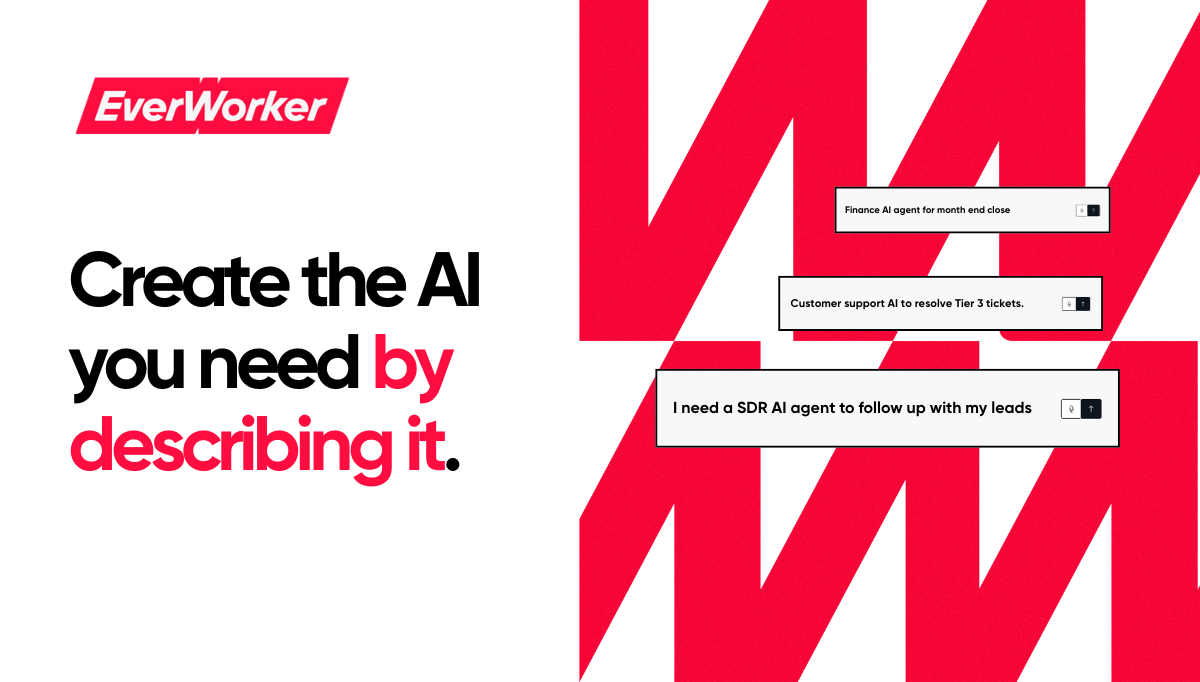
EverWorker puts AI to work for your business—fast. If you can describe how a task is done, you can create an AI worker to do it. No code. No technical complexity. No limits.
Built for line-of-business leaders in Marketing, Sales, Customer Support, Recruiting, Operations, and Finance, EverWorker turns your process know-how into production execution with unlimited capacity and process adherence. You get measurable business outcomes in hours, not months (typical).
Create AI workers just by describing how the job is done
Write instructions as if you hired a seasoned operator. Define the handoffs, decisions, systems, and approvals. EverWorker converts those instructions into a live AI worker that executes with accuracy and accountability.
The three steps to create and onboard AI workers
1) Describe the job and expected behavior
Write out how you want the work done—like a playbook for a new team member. Include research depth, reasoning style, prioritization rules, strategy frameworks, decision guidelines, approvals, and the exact handoffs across systems. Specify where actions happen in your process, how to log them, and when to escalate. You are not “prompting”; you are defining the role.
Example (Sales): “For each new MQL in HubSpot, review firmographics and intent, apply our ICP rubric, generate a 6-touch sequence aligned to persona, draft a 1-paragraph business case using our proof points, schedule sends via Outreach, and log activity back to the contact and account in CRM.”
2) Leverage relevant data and insight
Memories store the knowledge your AI workers need. Attach messaging, positioning, personas, assets, and proof for marketing; battle cards, ROI logic, and discovery frameworks for sales; escalation policies, entitlement rules, refund/warranty terms, and product configuration for support; JDs, scoring rubrics, interview kits, and hiring manager preferences for recruiting.
- Built-in web research: Workers can research live sources. A Marketing SEO worker analyzes the top 10 SERP results and stores them in a temporary vector space for drafting. A Sales business-case worker researches the prospect to ground impact statements in credible datapoints.
- System-connection skills for insight: A Financial Services thesis worker reads 10-Ks and deal systems to find targets. A Support worker looks up account entitlements and configuration in your CRM to tailor responses.
3) Connect to processes and systems to act
Skills execute tasks across your stack: research across web/APIs; design on-brand whitepapers, decks, and ads; write and send emails on your behalf; post to CMS; generate images; and more. Use MCP to standardize internal tools as callable capabilities and Workflows to orchestrate end-to-end automation.
- SDR AI Worker (Revenue): Every morning at 6am, pulls new MQLs from HubSpot, researches accounts, drafts tailored emails, loads Lemlist, activates the campaign, and logs every touch in CRM. Manager receives a summary of work performed.
- SEO Marketing Team: Keyword Researcher generates the content plan; Workflow passes it to the SEO Writer to research/write; an Image worker generates a header image; final assets publish directly to HubSpot CMS for same-day go-live.
- Universal Support Worker: Diagnoses issues, checks entitlement, issues credits, triggers logistics, and closes the loop across Zendesk, payments, ERP, and shipping—end to end with attributable audit history.
- Recruiting Ops: Drafts inclusive JDs, schedules multi-panel interviews, summarizes scorecards, and nudges hiring teams—while keeping ATS and HRIS perfectly updated.
Connectivity micro-guide
- API: High-throughput reads/writes mapped to named actions (e.g., create/update records in CRM, ERP, ATS).
- MCP: Standardize internal tools as callable skills for flexible orchestration (e.g., HubSpot MCP for retrieval and analysis).
- Webhooks: Event-driven triggers for real-time handoffs and state changes (e.g., “new opportunity created” → launch renewal playbook).
- Agentic browser: Last-mile execution where no API/MCP/webhook exists, with safeguards and auditability.
Governance in action: Role-based approvals, separation of duties, and attributable audit history are built in. You decide who can approve actions, which systems are writable, and where human-in-the-loop applies.
Typical time-to-value: hours to initial execution, days to production-grade handoffs for a single process; directional KPI lifts include time-to-live down 50–70% and time-to-hire down 20–30% when end-to-end workflows are connected.
| Marketing AI | HubSpot MCP: “Retrieve last 90 days of MQLs by persona, analyze conversion to SQL, identify top-performing messages, and draft three 6-touch sequences. Load sequences into Outreach and log to HubSpot contact records.” |
| Sales AI | Salesforce API: “For every new opportunity in Stage 2, generate a business case using our ROI model memory, attach as PDF to the opportunity, and notify the account team in Slack. Update fields for ‘Business Case Status’ and next best action.” |
| Support AI | Support + Webhooks: “When a ‘refund’ ticket is created in Zendesk, validate entitlement in billing, issue credit, generate RMA if needed, update ERP inventory, email the customer, and close the ticket with full audit notes.” |
Pick one process, connect three systems, go live in one working session
Choose a high-value workflow—SDR outreach, SEO content ops, returns and refunds, interview scheduling. Bring your instructions. In a working session, we’ll attach memories, map skills, connect systems, and switch an AI worker on. Your team experiences the impact immediately.
Book an EverWorker Platform Demo
This is a 45-minute strategic consultation, not a boilerplate demo. We’ll analyze your specific business processes and uncover your top 5 highest ROI AI use cases. We’ll identify which blueprint AI workers you can rapidly customize and deploy to see results in days, not months—eliminating the typical 6–12 month implementation cycles that kill momentum. You’ll leave with a prioritized roadmap: which processes to automate first, expected KPI lift, and how EverWorker accelerates time-to-value for your operation.
No generic slides—just strategic insight tailored to your stack and goals, led by our Head of AI.
This is the new way to scale: an AI workforce that follows your playbook, connects to your systems, and compounds results across the business. Create one worker. Then many. That’s workforce transformation.




 Anton Antich
 Austin Braham
 Christopher Good