


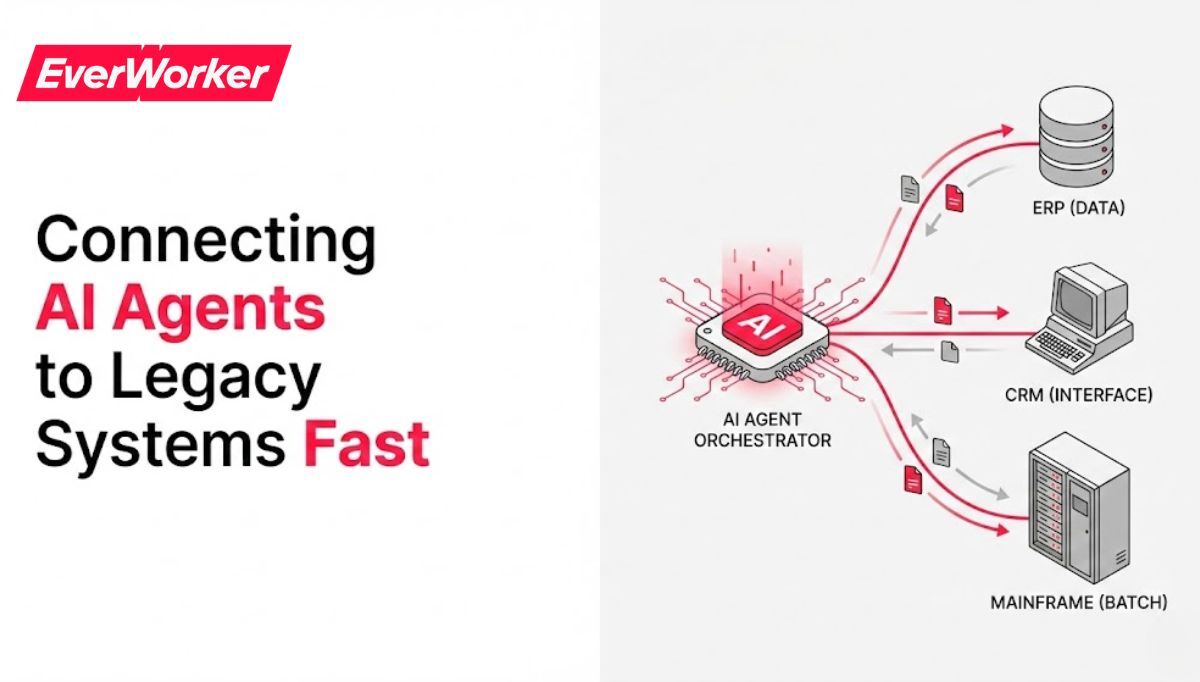
To integrate AI agents with legacy business systems, select the right connectivity pattern (APIs, iPaaS, or RPA bridges), map domain data into secure context (RAG/ETL), and enforce enterprise governance (SSO, RBAC, audit). Pilot in shadow mode, then phase to action with guardrails and measurement.
AI agents can unlock value in core systems you can’t easily rewrite. The fastest path is not ripping and replacing, but layering modern AI capabilities on top of what already runs your business. This guide shows how to connect agentic AI to ERPs, CRMs, mainframes, and line-of-business apps using proven integration patterns, secure data access, and governance you can take to audit. We’ll outline a practical, low-risk rollout that produces results in weeks, not months.
For composite line-of-business leaders, the goal is clear: increase capacity, reduce cycle time, and improve quality without destabilizing mission-critical systems. You’ll learn which integration approaches fit your stack, how to prevent security/compliance gaps, and how to build a 90-day roadmap from assessment to scaled deployment. We’ll also show where an AI workforce model outperforms tool-by-tool automation and how to avoid the common pitfalls that derail enterprise AI projects.
Choose integration patterns that fit legacy reality
Successful AI agent integration starts by matching patterns to your systems: use APIs where available, iPaaS for orchestration, and RPA bridges only when no programmatic interface exists. Event-driven and batch adapters ensure agents work with both real-time and scheduled systems.
Most legacy estates are heterogeneous. Some systems expose REST/GraphQL endpoints; others are locked behind client GUIs or batch jobs. A pragmatic design mixes patterns. Favor direct APIs through an API gateway when possible for reliability, security, and performance. Use iPaaS or enterprise service buses to orchestrate multi-app workflows and transform data. Apply RPA to bridge UI-only applications, then plan to replace bots with APIs as you modernize. This hybrid approach reduces risk while accelerating time-to-value.
When to use APIs vs RPA for legacy integration
Use authenticated APIs for deterministic, auditable operations and lower maintenance. Choose RPA for systems with no accessible API or for short-lived stopgaps. As you discover repeatable patterns, migrate RPA steps behind stable service endpoints to reduce brittleness and cost.
How iPaaS and middleware connect AI agents
Integration platforms (iPaaS/ESB) provide routing, transformations, retries, and monitoring. They let AI agents call named workflows (e.g., “create_sales_order”) instead of brittle step-by-step tasks. That abstraction improves security and uptime while giving IT centralized control.
Designing for event-driven and batch systems
Agents excel with events. Use webhooks, message queues, or CDC streams for real-time triggers. For mainframes and nightly jobs, create adapters: drop files to SFTP, read from shared queues, or trigger batch APIs so agents align with operational windows without breaking SLAs.
Deliver agent context with secure data pipelines
AI agents need context to act correctly. Build secure pipelines that map domain data, apply governance to sensitive fields, and provide retrieval-augmented generation (RAG) access to policies, procedures, and records. Start with read-only, then expand to write with approvals.
Reliable outcomes depend on clean, contextual data. Define canonical objects (customer, order, asset), map fields from each source system, and normalize identifiers. Use data contracts so agents know which attributes are authoritative and which are advisory. For unstructured content, stage policies, SOPs, and knowledge base articles in searchable stores to support RAG. Treat PII and regulated data with field-level controls and audit every retrieval to satisfy compliance teams.
How to build RAG pipelines on enterprise data
Ingest docs to a vector index with metadata (system of record, effective date, region). Enforce access via row- and column-level security. At runtime, agents retrieve only what they’re entitled to and cite sources in outputs to improve trust and reviewability.
Bridging batch and mainframe workflows
For COBOL/batch systems, wrap JCL jobs behind controlled triggers and expose status via a queue. Agents request work, receive a job ID, and poll or subscribe to completion events. This preserves mainframe reliability while enabling AI-driven orchestration.
Master data, PII, and lineage management
Connect agents to master data hubs and apply data masking to PII where possible. Capture lineage from source to action so you can answer “which data drove this decision?” during audit. Align with GDPR, HIPAA, and SOX obligations by design.
Govern AI agent actions with enterprise controls
Make agents first-class, governed identities. Use SSO, role-based permissions, and environment scoping. Add guardrails, approval workflows, and detailed logs so every action is explainable and reversible without production risk.
Security and compliance are non-negotiable in legacy estates. Register agents in your IdP, assign least-privilege roles, and segment environments (dev/test/prod) with separate credentials. Implement policy checks before high-risk actions, require human approvals where needed, and ensure full observability: inputs, retrieved context, chosen tools, and system responses. This turns AI from “black box” to well-governed automation your risk team can support.
Authenticating agents: SSO, OAuth, and mTLS
Use service principals with OAuth/OIDC for SaaS apps and mTLS/API keys via gateways for internal services. Rotate secrets automatically. Tag every call with a unique agent ID to separate duties and trace activity across systems.
Designing guardrails and approvals
Codify preconditions (thresholds, dollar limits, data quality checks) and route exceptions to a human queue. For sensitive actions (refunds, journal entries), require an approval step with diff views and full context to prevent accidental or malicious changes.
Audit, logging, and model risk management
Log prompts, retrieved documents, tools used, and outputs with hashes and timestamps. Store summaries in your SIEM for anomaly detection. Maintain a model registry with performance tests and rollback procedures to satisfy model risk governance.
Rethinking integration: from tasks to processes
The old way automates tasks in isolation. The new way orchestrates end-to-end processes with AI workers that read policies, coordinate systems, and deliver outcomes. This shift turns fragile scripts into resilient, auditable, outcome-driven workflows.
Many teams start with a chatbot or point automation and stall because fragmented tools don’t own outcomes. Leaders are moving to an AI workforce approach: specialized agents that handle deep domain tasks under a universal orchestrator that understands business rules and context. Instead of wiring every step, you declare the outcome (“process a warranty claim”), and the orchestrator invokes the right skills, systems, and approvals. According to Gartner’s 2024 survey, generative AI is now the most frequently deployed AI class, but value concentrates where it’s embedded into business processes rather than used as standalone tools.
Why point tools falter without orchestration
Point automations don’t track cross-system dependencies, handle exceptions, or adapt to policy changes. An orchestrated AI workforce embeds policies, context, and fallbacks, so processes keep running when one system hiccups or a rule changes.
AI workers as your new integration layer
Think beyond task bots. Treat AI workers like digital employees with defined roles, access, and KPIs. They connect through your gateways, consume approved knowledge, and deliver measurable outcomes with audit trails your risk and compliance teams can trust.
Implementation Roadmap
Follow a phased, 90-day plan: assess and prioritize, run a shadow pilot, graduate to guarded write actions, then scale to additional processes. Measure impact continuously and harden governance as you expand.
- Week 0-2: Assessment & Prioritization. Inventory systems, access methods (API, batch, UI), and data sensitivity. Select 2-3 high-volume, rules-heavy processes (e.g., invoice triage, returns authorization). Establish baselines for cycle time, error rate, and cost-per-transaction.
- Week 2-4: Build “Read-Only” Shadow Pilot. Stand up connectors and RAG. Let agents propose actions while humans execute. Compare agent recommendations against human outcomes to validate accuracy and surface gaps.
- Day 30-60: Guarded Write Actions. Enable low-risk writes (ticket notes, draft emails) and approval-based writes for sensitive steps (refunds, GL entries). Tighten RBAC and finalize audit logging and dashboards.
- Day 60-90: Scale & Optimize. Add processes with similar patterns. Replace any brittle RPA steps with API/iPaaS endpoints. Expand metrics to include customer/employee satisfaction and exception throughput.
For deeper implementation guidance in customer operations, see our guide to AI customer support integration and how AI workers transform support operations.
How EverWorker unifies legacy integration
EverWorker applies the “AI workforce” model so business leaders can integrate AI agents with legacy systems in days, not months. Two capabilities make this possible: EverWorker Creator and Universal Connector.
EverWorker Creator functions like an always-on AI engineering team. You describe the process (“When a warranty email arrives, verify eligibility in ERP, create an RMA, email the label, and update CRM”). Creator builds a specialized AI worker plus the orchestration logic, tests it in your Canvas, and deploys with guardrails. No code required. Business users can refine steps conversationally, while IT retains governance and access control.
Universal Connector gives AI workers immediate, governed access to your systems. Upload an OpenAPI spec and the Connector exposes safe, named actions; for systems without clean specs, define the actions you allow. Workers authenticate via your IdP, operate with least privilege, and every call is logged. For UI-only legacy apps, workers can temporarily invoke RPA bridges until an API endpoint is available. This approach preserves reliability while accelerating integration.
Customers typically see first-value use cases go live in under two weeks, with cycle time reductions of 25-60% and significant error-rate drops as workers follow policies consistently. For a full platform overview, explore EverWorker Creator and our perspective on AI trends in operations.
Actionable next steps
Here’s a practical sequence you can start this week. It builds momentum quickly while keeping risk low and stakeholders aligned.
- Immediate (This Week): Run a 2-hour integration audit: list top 10 processes causing delays, note system access (API/RPA/batch), and flag compliance constraints. Choose one process that is rules-heavy and high-volume.
- Short Term (2-4 Weeks): Stand up a read-only pilot with RAG access to policies and knowledge. Have the agent propose actions in a shared channel while humans execute, and track agreement rate and reasons for overrides.
- Medium Term (30-60 Days): Enable guarded writes with approvals on the pilot process. Publish RBAC, logging, and rollback procedures. Set targets for cycle time and accuracy uplift.
- Strategic (60-90+ Days): Expand to 2-3 adjacent processes with similar integration patterns. Replace brittle RPA segments with API/iPaaS endpoints. Formalize KPIs as “digital workforce” metrics on your ops dashboard.
- Transformational: Establish a universal AI worker that orchestrates specialized workers across functions (support, finance, supply chain) with shared governance and knowledge.
The fastest path forward starts with building AI literacy across your team. When everyone from executives to frontline managers understands AI fundamentals and implementation frameworks, you create the organizational foundation for rapid adoption and sustained value.
Your Team Becomes AI-First: EverWorker Academy offers AI Fundamentals, Advanced Concepts, Strategy, and Implementation certifications. Complete them in hours, not weeks. Your people transform from AI users to strategists to creators—building the organizational capability that turns AI from experiment to competitive advantage.
Immediate Impact, Efficient Scale: See Day 1 results through lower costs, increased revenue, and operational efficiency. Achieve ongoing value as you rapidly scale your AI workforce and drive true business transformation. Explore EverWorker Academy
Ship Value in Weeks
Integrating AI agents with legacy business systems doesn’t require a risky rewrite. Use the right pattern per system, provide governed context, and enforce enterprise-grade controls. Pilot in shadow mode, then scale guarded writes. An AI workforce approach turns fragile task automation into resilient process orchestration that delivers measurable results fast. Your core systems stay stable; your capacity and agility leap forward.
Additional reading: TechTarget on modernizing legacy with AI and Gartner on sustained AI operations.




 Anton Antich
 Austin Braham
 Christopher Good