


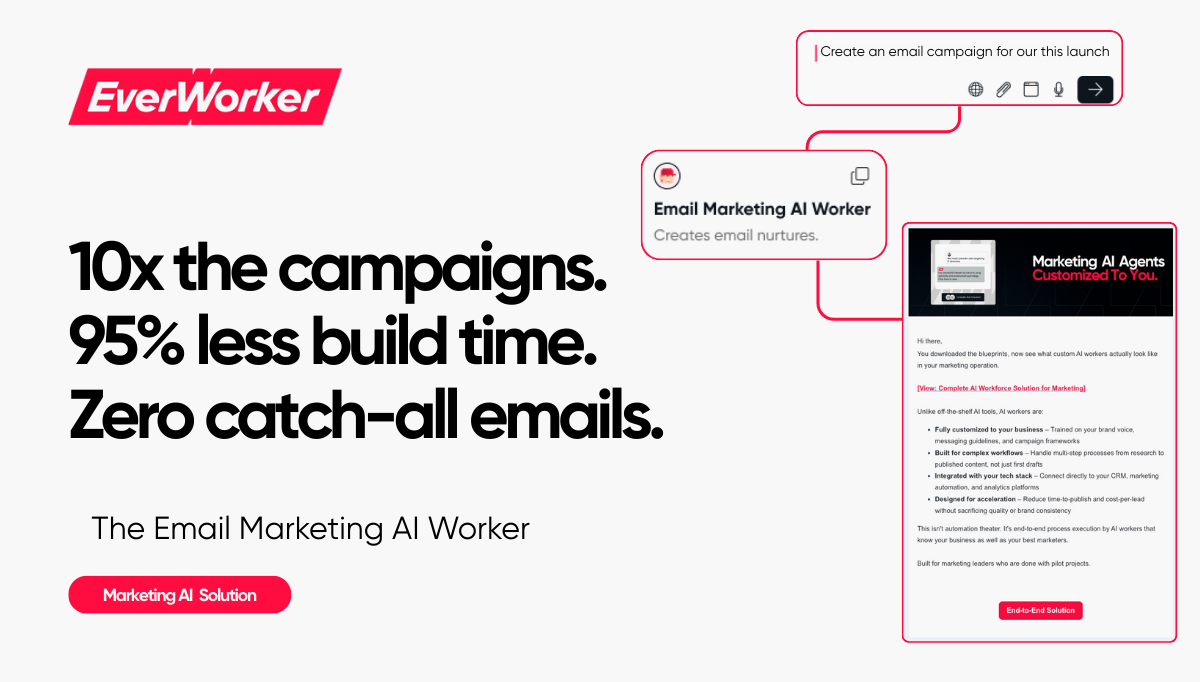
Email delivers $36 for every $1 spent—a 3600% ROI that makes it the highest-performing marketing channel available. Yet according to industry research, the two main issues marketers face are building (41%) and designing (40%) their email campaigns. For most teams, we have the segment data and the product insights, but the manual grind of building a single campaign often feels like assembling a watch by hand.
This is the email paradox: the channel with the highest ROI is also the one where execution bottlenecks kill your potential.
I've lived through countless launches where we had five distinct audience segments but only one "catch-all" email because we didn't have the time to build five versions. It's a PMM's nightmare: knowing your messaging is too generic but being physically unable to fix it before the send date.
The Email Marketing AI Worker eliminates that compromise. It isn't just a shortcut; it's the professional-grade engine that finally lets you execute at the speed of your ideas. This article shows you exactly how it works, what it produces, and how to build one for your organization.
What the Email Marketing AI Worker Does
The Email Marketing AI Worker functions as your always-on email production team. It automates your entire email marketing production workflow—from subject lines optimized for opens, to compelling copy tailored to each audience segment, to finished emails built directly in your marketing automation platform.
This AI Worker:
- Writes subject lines and preview text optimized for open rates using historical performance data
- Crafts compelling email copy personalized to each audience segment
- Designs responsive email templates that match your brand guidelines
- Builds finished emails directly in your CMS—HubSpot, Marketo, Salesforce Marketing Cloud, Klaviyo, Mailchimp, or Iterable
- Generates A/B test variants for subject lines and content
- Produces performance reports that identify your next growth lever
Instead of piecemeal AI tools, this AI Worker operates through orchestrated agent workflows: Strategy Agent → Subject Line Agent → Copywriting Agent → Design Agent → Build Agent → QA Agent—each performing its task and collaborating for a frictionless brief-to-deployed-campaign journey.
What Is an AI Worker?
Before going deeper, let me clarify what this is—because it represents a fundamental shift in how we should think about AI.
An AI Worker is not a chatbot. It's not an email assistant. It's not a tool you prompt.
An AI Worker is a digital employee with permanent knowledge, specialized skills, and the ability to execute complex workflows autonomously. You don't have a conversation with it. You delegate to it.
Think about the difference between asking a colleague a question versus assigning them a project. When you assign a project, you expect them to already understand the context of your business, know how to do research without being told, follow your established processes and quality standards, use the right tools for the job, and deliver finished work—not drafts that need extensive editing.
That's what an AI Worker does. And the Email Marketing AI Worker does it for email campaigns at scale.
How It Works: The Complete System
The Email Marketing AI Worker transforms a simple input—a campaign brief with audience segment, offer, CTA, send date, and email type—into a complete, deployed email campaign. No template wrestling. No copy-paste errors. No Thursday nights QA-ing responsive templates.
Here's what happens under the hood:
Phase 1: Strategic Analysis
When the AI Worker receives your campaign brief, it doesn't immediately start writing. It starts thinking.
Performance Mining: The worker retrieves your past email performance data, subject line testing results, and engagement patterns from its knowledge base. It understands what's worked for this audience segment before.
Competitive Context: Based on your industry and audience, it analyzes competitor email approaches and identifies patterns in subject lines, offers, and CTAs that drive engagement.
Audience Mapping: The worker maps your segment data to the appropriate messaging framework. A nurture sequence for cold leads requires different treatment than a promotional blast to engaged customers.
Phase 2: Subject Line Optimization
The AI Worker has proven subject line frameworks built into its knowledge:
- Curiosity Gap: Creates intrigue without clickbait
- Benefit-First: Leads with the value proposition
- Urgency/Scarcity: Time-sensitive or limited availability
- Personalization: Dynamic insertion of name, company, or behavioral data
- Social Proof: Leverages results or testimonials
The AI Worker selects the appropriate framework based on your email type, audience segment, and historical open rate data. It generates multiple variants for A/B testing—because research shows A/B split testing leads to a 28% higher return.
Phase 3: Copy Generation
Now the AI Worker writes. But unlike a chatbot producing generic content, it follows a precise copywriting architecture:
Segment-Specific Messaging: Each audience segment receives copy tailored to their stage in the buyer journey, their pain points, and their engagement history. No more "catch-all" emails.
Brand Voice Enforcement: The worker references your brand guidelines, tone documentation, and approved messaging frameworks to ensure every email sounds like your company—not generic AI.
CTA Optimization: Calls-to-action are crafted based on conversion data, using first-person language where research shows it improves clicks by up to 90%.
Phase 4: Design and Build
Before your team ever sees the email, the AI Worker handles production:
Template Selection: Based on email type and content requirements, the worker selects the appropriate responsive template from your approved library.
Design Assembly: Visual elements, images, and layout are assembled according to your brand guidelines and mobile optimization requirements—critical since 50% of recipients will delete an email that isn't mobile-optimized.
Platform Build: The finished email is built directly in your marketing automation platform. No exporting, importing, or manual recreation. It's ready for review in HubSpot, Marketo, Klaviyo, or your CMS of choice.
Phase 5: Quality Assurance
Before delivery, the AI Worker executes a comprehensive QA pass. It asks itself:
- Does this email match our brand voice and visual identity?
- Are all personalization tokens rendering correctly?
- Is the email responsive across all device types?
- Do all links point to the correct destinations?
- Does the content comply with our legal and compliance requirements?
These guardrails are in the system, not in manual review.
The Results: What AI-Powered Email Production Looks Like
The organizational impact here isn't just "more email"—it's a fundamental shift in how marketing teams allocate resources.
| Metric | Result |
|---|---|
| Email Volume | 10x more email campaigns deployed per month |
| Production Time | 95% reduction in email creation time |
| Open Rates | 25-40% improvement through optimized subject lines |
| Click Rates | 30-50% improvement through personalized content |
| Consistency | 100% brand and template compliance |
Let me put this in perspective:
Precision Targeting for Higher Intent: We aren't just sending more mail; we're sending better mail. With a 30-50% improvement in click rates through personalized content, you're driving higher-quality traffic to your sales team. Research confirms that detailed email segmentation leads to 30% more opens and 50% more clicks than unsegmented campaigns.
The Velocity Advantage: A 95% reduction in email creation time means you can respond to market triggers instantly. If a competitor drops a price or a new industry trend emerges, you have a tailored nurture sequence live in hours, not days.
Engagement That Sticks: By optimizing subject lines for a 25-40% improvement in open rates, the AI ensures your product stories actually get read instead of buried. When you consider that automated emails generate 320% more revenue than non-automated campaigns, the compounding effect is massive.
The Strategic Shift: The real magic for the PMM team is the 95% reduction in production time. When you stop being "email builders," you start being market strategists. Instead of spending Thursday nights QA-ing responsive templates and subject line variants, your team is analyzing performance reports—which this worker also generates—to find the next big growth lever.
Build Your Own Email Marketing AI Worker
The Email Marketing AI Worker is built on EverWorker's AI Worker platform. That means you can build something similar for your own organization—customized to your brand, audience segments, email templates, and marketing automation stack.
Here's what it takes:
Step 1: Document Your Email Process
Start by articulating exactly how your best email campaigns get created. What research does your team do before writing? What makes a good subject line at your company? What's your preferred structure for nurture vs. promotional emails? The more specific you can be, the better your AI Worker will perform.
Step 2: Define Your Quality Bar
Upload examples of your best-performing email campaigns. Define what "good" looks like. Include your brand voice guidelines, approved templates, and compliance requirements. This is what makes the output feel like your brand, not generic AI content.
Step 3: Build In Self-Checks
Throughout the AI Worker's instruction set, embed self-checks: "Does this subject line match our brand voice?" "Is this CTA clear and actionable?" "Are all personalization tokens correct?" These guardrails maintain quality at scale.
Step 4: Connect Your Tools
EverWorker uses universal connectors to integrate with your existing stack. The Email Marketing AI Worker connects to HubSpot, Marketo, Salesforce Marketing Cloud, Klaviyo, Mailchimp, or Iterable for direct campaign building. Your AI Worker uses these tools autonomously—no manual handoffs.
Step 5: Iterate from Assist to Autonomous
Don't start with full automation. Start with what we call "agent assist"—working interactively with the AI until you've validated the exact input format and output quality you want. Once you've reviewed enough outputs to trust the system, promote it to autonomous.
This progression is how you build reliable AI Workers.
Ready to Build Your Own?
If you're ready to stop treating email as a "manual build" and start treating it as a scalable demand generation engine, we have two paths forward:
Book a Strategy Call: Get a personalized roadmap for your AI webinar engine. We'll map your current process, identify automation opportunities, and show you exactly what an AI-powered webinar workflow would look like for your organization.
Enroll in EverWorker Academy: Our free certification program teaches you how to build AI Workers like the Webinar Marketing AI Worker. Learn the principles, see the patterns, and apply them to your own use cases.
The Future of Email Marketing
Here's what I want you to take away from this:
If you can describe the work, you can automate it.
The barrier isn't technology—it's clarity of process. The marketing teams that will win in the next decade aren't necessarily the ones with the biggest email lists or the most expensive automation platforms. They're the ones that can clearly articulate what excellent email looks like and encode that understanding into AI Workers.
This isn't about AI replacing email marketers. It's about AI handling the execution so your team can focus on what actually requires human judgment: messaging strategy, audience insight, campaign architecture, and the ideas that make content worth opening.
This worker transforms email from a "chore" into a scalable revenue driver. It ensures that every piece of product news you produce finds its way to the right inbox, with the right message, at exactly the right time.
That's what the Email Marketing AI Worker can give you. And it's what AI Workers can give you too.




 Ameya Deshmukh
 Anton Antich
 Austin Braham