


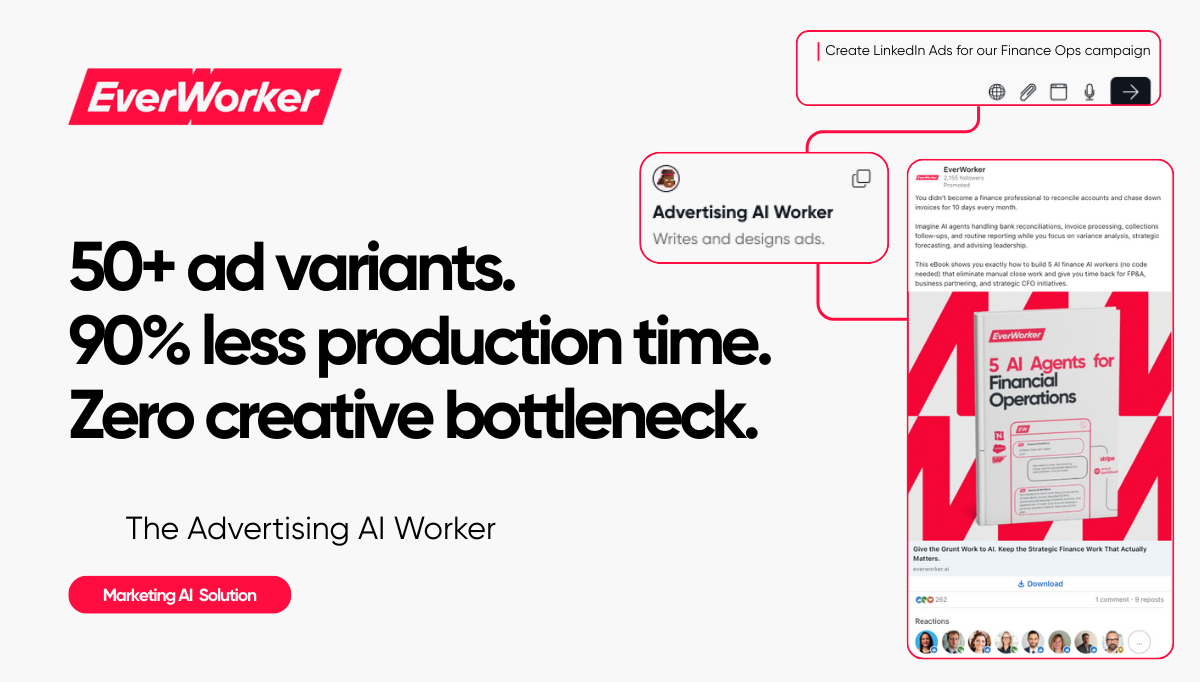
Advertising AI Worker
From Creative Bottleneck to Always-On Demand Generation—Automatically
Nielsen research confirms that creative drives 49-56% of sales impact in advertising—yet brands using automation for A/B testing complete 4.3x more experiments per campaign than manual-only teams. The math is brutal: your creative is the single biggest lever for paid performance, but most teams can only test a fraction of what they should.
I've spent ten years in the trenches of integrated marketing, and if there's one recurring nightmare that keeps Directors like me up at night, it's the creative bottleneck. The cycle was always the same: Sales would scream for more leads, we'd have a brilliant campaign strategy ready to go, and then… we'd wait. We'd wait three weeks for design to resize banners for LinkedIn. We'd wait for copy to churn out five different headlines for A/B testing. By the time the ads went live, the market had shifted, and Sales was already looking at a "missed" month.
When Marketing can only produce 5-10 ad variants manually, we're essentially guessing what will work. It's not a strategy—it's a lottery ticket.
The Advertising AI Worker changes that dynamic entirely. It's not just a tool; it's like adding a high-octane engine to a bicycle. This article shows you exactly how it works, what it produces, and how to build one for your organization.
What the Advertising AI Worker Does
The Advertising AI Worker functions as your always-on creative production team. It generates complete advertising campaigns across every paid channel—writing compelling ad copy with multiple variants for A/B testing, designing eye-catching visuals sized for each platform, creating audience targeting recommendations, and organizing assets for easy campaign deployment.
This AI Worker:
- Writes ad copy variants optimized for each platform's best practices and character limits
- Designs display ads, carousel ads, and video ad concepts in your brand style
- Generates 50+ creative variants per campaign for comprehensive A/B testing
- Sizes and formats assets for Google, Meta, LinkedIn, and every paid channel
- Creates audience targeting recommendations based on your offer and objectives
- Produces A/B testing matrices so you know exactly what to test and why
Instead of piecemeal AI tools, this AI Worker operates through orchestrated agent workflows: Strategy Agent → Copywriting Agent → Design Agent → Variant Generation Agent → Platform Sizing Agent—each performing its task and collaborating for a frictionless brief-to-deployed-campaign journey.
What Is an AI Worker?
Before going deeper, let me clarify what this is—because it represents a fundamental shift in how we should think about AI.
An AI Worker is not a chatbot. It's not an ad assistant. It's not a tool you prompt.
An AI Worker is a digital employee with permanent knowledge, specialized skills, and the ability to execute complex workflows autonomously. You don't have a conversation with it. You delegate to it.
Think about the difference between asking a colleague a question versus assigning them a project. When you assign a project, you expect them to already understand the context of your business, know how to do research without being told, follow your established processes and quality standards, use the right tools for the job, and deliver finished work—not drafts that need extensive editing.
That's what an AI Worker does. And the Advertising AI Worker does it for paid media creative at scale.
How It Works: The Complete System
The Advertising AI Worker transforms a simple input—a campaign brief with target audience, offer, CTA, budget parameters, and channel priorities—into a complete, multi-variant creative package ready for deployment. No three-week wait for design. No copy bottleneck. No manual resizing across platforms.
Here's what happens under the hood:
Phase 1: Strategic Analysis
When the AI Worker receives your campaign brief, it doesn't immediately start creating. It starts thinking.
Performance Mining: The worker retrieves your past ad performance data—what headlines, hooks, and visuals have worked for this audience. It identifies patterns in your winning creative.
Competitive Intelligence: The worker analyzes competitor ads to understand what's currently in-market, ensuring your creative stands out rather than blends in.
Platform Optimization: Based on your channel priorities, it maps each platform's best practices—character limits, aspect ratios, engagement patterns, and placement requirements.
Phase 2: Copy Generation
The AI Worker has proven advertising copywriting frameworks built into its knowledge:
- Problem-Agitate-Solution: For audiences who need to feel the pain before seeing the solution
- Benefit-First: Leading with the value proposition for high-awareness audiences
- Social Proof: Leveraging testimonials and results for credibility-focused messaging
- Curiosity Gap: Creating intrigue that drives clicks without clickbait
The AI Worker selects the appropriate framework based on your audience awareness level, offer type, and historical performance data. Then it generates multiple headline, body copy, and CTA variants for comprehensive testing.
Phase 3: Visual Creation
Now the AI Worker designs. But unlike generic AI image generation, it follows your brand architecture:
Brand Consistency: The worker references your brand guidelines—colors, fonts, imagery style, logo placement—ensuring every asset feels unmistakably yours.
Format Optimization: Different creative approaches for different placements: scroll-stopping visuals for feed ads, clear value props for sidebar placements, motion concepts for video inventory.
Variant Generation: Multiple visual approaches are created—different imagery, different layouts, different emphasis—so you can test visual direction alongside copy.
Phase 4: Variant Matrix Construction
Before delivery, the AI Worker builds your testing framework:
- Headline variants × Body copy variants × Visual variants = Complete A/B testing matrix
- Priority ranking based on predicted performance
- Platform-specific recommendations for which variants to test where
- Statistical guidance on budget allocation for valid test results
This isn't random variation—it's systematic testing infrastructure.
Phase 5: Platform Sizing and Delivery
The final output isn't just one set of ads. The AI Worker delivers:
- Complete creative packages sized for Google Display Network, LinkedIn, Meta, and your priority channels
- Organized asset folders with clear naming conventions
- Copy documents with all variants mapped to visuals
- Campaign setup recommendations including audience targeting and budget allocation
Every asset perfectly formatted and brand-consistent across every paid channel.
The Results: What AI-Powered Creative Production Looks Like
The organizational impact here isn't just "more ads"—it's a fundamental shift from production to performance.
| Metric | Result |
|---|---|
| Creative Volume | 50+ ad variants per campaign vs. 5-10 manually |
| Time Savings | 90% reduction in creative production time |
| Testing Velocity | 10x more A/B tests running simultaneously |
| Cost Per Lead | 30-50% reduction through optimized creative |
| Channel Coverage | Consistent creative across all paid channels |
Let me put this in perspective:
Bridging the Marketing-Sales Divide: In any high-growth org, the friction between Marketing and Sales usually boils down to volume and velocity. Sales needs a constant stream of high-quality leads. When we could only produce 5-10 variants manually, we were essentially guessing. With 50+ variants per campaign, we're not just "supporting" Sales; we're proactively feeding them. We can test hyper-specific messaging for different industry segments simultaneously.
From Production to Performance: The real magic happened in our Cost Per Lead. By having the testing velocity to run 10x more A/B tests, we found our winning creative 90% faster. If a specific hook started converting like crazy, we could double down on that creative across Meta, Google, and LinkedIn in hours, not weeks.
Pipeline Velocity: Because production time dropped by 90%, our speed-to-lead at the top of the funnel skyrocketed. We were hitting the market while the demand was hot—no more "dark periods" where campaigns were paused waiting for assets.
Creative Liberation: This worker didn't replace my team; it liberated them. My creative leads stopped acting like production factories resizing files in Figma and started acting like Strategists. They began focusing on feeding the AI better brand guidelines, deeper competitor insights, and more nuanced audience data.
Build Your Own Advertising AI Worker
The Advertising AI Worker is built on EverWorker's AI Worker platform. That means you can build something similar for your own organization—customized to your brand, audiences, channels, and creative approach.
Here's what it takes:
Step 1: Document Your Creative Process
Start by articulating exactly how your best-performing ads get created. What research does your team do before concepting? What makes a great headline at your company? What visual approaches have worked historically? The more specific you can be, the better your AI Worker will perform.
Step 2: Define Your Quality Bar
Upload examples of your highest-converting ads. Define what "good" looks like. Include your brand guidelines, approved imagery styles, and messaging frameworks. This is what makes the output feel like your brand created it, not generic AI.
Step 3: Build In Self-Checks
Throughout the AI Worker's instruction set, embed self-checks: "Does this headline match our brand voice?" "Is this visual on-brand?" "Does this CTA align with campaign objectives?" These guardrails maintain quality at scale.
Step 4: Connect Your Tools
EverWorker uses universal connectors to integrate with your existing stack. The Advertising AI Worker connects to Google Ads, LinkedIn Campaign Manager, and Meta Ads Manager for direct deployment, plus Canva, Figma, or Adobe Creative Suite for design workflows. Your AI Worker uses these tools autonomously—no manual handoffs.
Step 5: Iterate from Assist to Autonomous
Don't start with full automation. Start with what we call "agent assist"—working interactively with the AI until you've validated the exact creative quality and variant volume you want. Once you've reviewed enough outputs to trust the system, promote it to autonomous.
This progression is how you build reliable AI Workers.
Ready to Build Your Own?
If you're ready to stop waiting weeks for creative and start treating paid media like an always-on demand generation engine, we have two paths forward:
Book a Strategy Call: Get a personalized roadmap for your AI creative production engine. We'll map your current process, identify automation opportunities, and show you exactly what an AI-powered advertising workflow would look like for your organization.
Enroll in EverWorker Academy: Our free certification program teaches you how to build AI Workers like the Advertising AI Worker. Learn the principles, see the patterns, and apply them to your own use cases.
The Future of Advertising Creative
Here's what I want you to take away from this:
If you can describe the work, you can automate it.
The barrier isn't technology—it's clarity of process. The marketing teams that will win in the next decade aren't necessarily the ones with the biggest creative teams or the most expensive agencies. They're the ones that can clearly articulate what excellent advertising looks like and encode that understanding into AI Workers.
This isn't about AI replacing creative directors. It's about AI handling the production so your team can focus on what actually requires human judgment: brand strategy, audience insight, creative direction, and the ideas that make campaigns memorable.
When your creative production is automated, your Demand Generation becomes an always-on machine. The result? A predictable, scalable pipeline. When Sales sees that Marketing can pivot messaging in a day to support a new product launch or a competitive counter-move, the trust between the two departments reaches a whole new level. You're not just a "cost center" anymore—you're the primary driver of their revenue growth.
That's what the Advertising AI Worker can give you. And it's what AI Workers can give you too.




 Ameya Deshmukh
 Anton Antich
 Austin Braham