

Imagine a familiar scenario. You're hiring. Two SDRs. A GTM engineer. An SDR manager. Two AEs. Your target is 100 BANT-qualified opportunities this quarter. That means 200 qualified meetings. Which means 300 first calls booked to account for no-shows and disqualification.
There's the conventional way to run this. The proven playbook. With proven constraints.
That's now how AI-First SDR teams operate.
The Industry Standard Playbook
Approach A: Templated sequences. Name, company, industry, title dropped into a template. A/B test subject lines. A/B test body copy. Optimize open rates and reply rates. This is the default motion at most companies.
A two-person SDR team running templated sequences at scale will book meetings at a 0.5% to 1.5% rate on contacted leads. The emails feel generic because they are. Prospects see dozens of these a week. Your SDRs will spend their days tweaking subject lines and swapping one template for another, chasing marginal gains in open rates that never translate to replies. At 4,000 contacts per month, you're looking at 20 to 60 first calls booked per month. Hitting 300 for the quarter is a stretch. Hitting it consistently is unlikely.
Approach B: Apollo with GPT spyntax. Five automated sequences, one per persona. AI-generated variations at the syntax level. Better than pure templates. Still a volume play with surface-level personalization.
Reply rates improve slightly. You might see 1% to 2% booking rates. But the personalization is cosmetic. The emails read like they were written by a machine that knows your job title but not your business. Your SDRs are now managing automation tools instead of writing emails, but the output still doesn't feel like a human sat down and thought about the prospect's actual situation. You're in the 30 to 80 first calls per month range. Better. Still not enough.
Approach C: True account-based sequences. The SDR researches the account. Builds a business case. Maps the buying group. Writes a custom four-email sequence for each contact that is unique to the person and unique to the company. Every sales leader knows this is the approach that works.
An SDR doing this properly spends 45 to 90 minutes per contact. That's 8 to 12 contacts per day. Two SDRs produce maybe 100 fully personalized sequences per week. At that pace, reaching 4,000 contacts takes 40 weeks. You have 12. And the quality won't stay consistent. By contact number 50 in a week, your SDRs are cutting corners. The research gets thinner. The emails get more formulaic. The thing that makes Approach C work is the thing that makes it impossible to sustain.
The Constraint Nobody Talks About
Every outbound motion hits the same wall. When it starts working, it starts breaking.
Your SDRs book more meetings. Those meetings consume hours. Prep time. Call time. Follow-up time. CRM notes. Every meeting booked is an hour that can no longer be spent generating the next one. The more successful your outbound program becomes, the less capacity your team has to run it.
Two SDRs spending 60% of their week on meetings have maybe 15 to 20 hours combined for actual outbound work. That's research, writing, list building, sequencing, and managing replies. The math doesn't hold. Your pipeline generation declines exactly when your pipeline starts filling. Then you miss next month's target because this month went well.
This is the structural limit of the conventional motion. A time problem. You can't hire your way out of it fast enough.
Same Team. AI SDR Worker. Different Quarter.
Same two SDRs. Same GTM engineer. Same SDR manager. Same two AEs. Same target. Same 600,000 contacts.
The AI SDR Worker does what Approach C does. It researches the account. It maps the buying group. It writes a custom four-email sequence for each contact that is unique to the person and unique to the company. It follows the exact playbook your best SDR manager would run. Your team's best practices, positioning, and insights are built into how it writes.
It does this for 10,000 contacts in a single workday. We haven't found the ceiling yet because no client has pushed volume high enough to reach it.
The token cost to sequence one contact is less than a penny. For 100,000 contacts, total cost is $823. Compare that with the 45 to 90 minutes an SDR spends doing the same thing for a single contact.
What Your Team Actually Does Now
Your SDRs spend 80% of their week in meetings. Not because they're overwhelmed. Because they can. The AI SDR Worker handles the outbound generation that used to consume their days. Every morning, hours open up for power dialing programs. Hours open for signal-based outbound and strategic plays with AEs and the SDR manager.
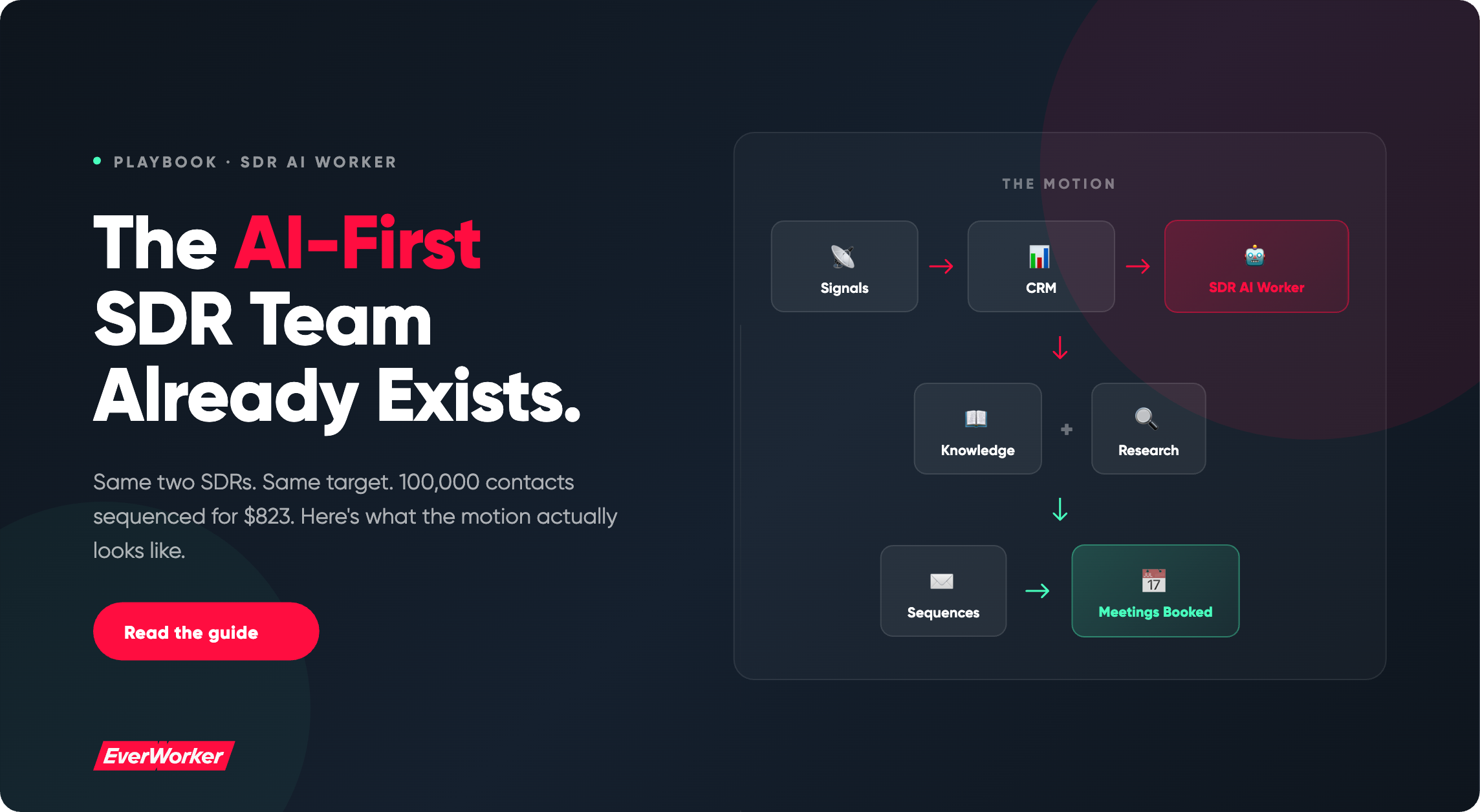
The workflow is simple. SDRs put contacts into the CRM from anywhere. They set a field to true. The AI SDR Worker picks them up automatically. A fully personalized outbound campaign launches in 30 minutes. No sequence building. No template management. No research sprints.
Your GTM engineer shifts from configuring outbound tools to building signal orchestration. They create enrichment agents. They implement deanonymization technology. They manage the data properties that continuously improve what flows into the AI SDR Worker. The machine gets smarter because your GTM engineer makes it smarter.
Your SDR manager stops managing email output and starts managing meeting quality, conversion rates, and strategic account plays. The job becomes coaching and deal strategy instead of template reviews and activity metrics.
Which Team Hits Their Number?
Team A has two SDRs splitting their time between writing emails and taking meetings, a GTM engineer keeping tools configured, and a manager reviewing sequences. They're fighting the constraint loop every week. The better they perform, the less time they have to keep performing.
Team B has two SDRs in meetings all day building pipeline through conversations, a GTM engineer orchestrating signals that feed an AI Worker running Approach C at unlimited scale, and a manager focused on conversion and strategy. Outbound never slows down. Meeting volume never cannibalizes prospecting capacity. The constraint loop is broken.
One of these teams hits 100 qualified opportunities this quarter. The other one gets close and stalls.
You already know which one.
This Is the Foundation
The SDR AI Worker is the base layer of an AI-first sales operating model. Once outbound sequencing runs at scale without consuming human hours, every other part of your go-to-market gets better.
Do more with more.

Comments